Choosing Clinical Diagnostic Equipment: Not One-Size-Fits-All – A Quality Manager’s Perspective
A quality compliance manager explains how to choose between systems like Sysmex analyzers, fetal monitors, hospital beds, and deep brain stimulators, based on your lab's scale and priorities.
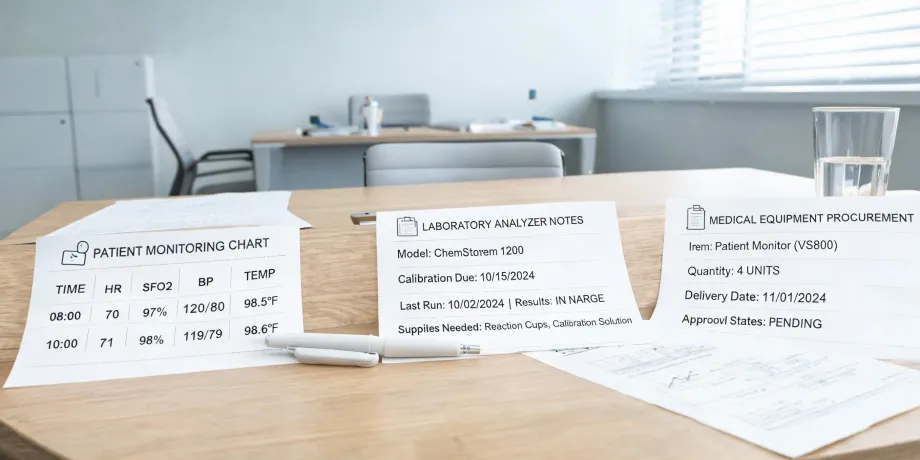
If you're specifying equipment for a hospital lab or a research clinic, you've probably noticed something: the standard advice online is often useless. It'll tell you to 'look for accuracy and reliability'—as if you were going to pick something inaccurate and unreliable. I'm a quality compliance manager. I review roughly 200+ pieces of equipment documentation annually before anything reaches our customers. From that seat, the question isn't 'which brand is best?' The question is 'which solution fits your specific workflow?' There is no universal answer. Here's how to figure out yours.
Three Common Scenarios, Three Different Priorities
In my experience, most buyers fall into one of three distinct scenarios. The mistake is treating all three the same way.
Scenario A: The High-Volume Core Lab
You're processing 500+ samples a day. Your lab runs shifts. Turnaround time is the metric everyone watches. In this scenario, throughput and uptime dominate every other consideration. A system like the Sysmex XN series (with its high-throughput capabilities) or a fully automated coagulation line makes sense—not because it's 'better' technology, but because downtime costs you hours of productivity. In our Q1 2024 quality audit, we tracked that a single hour of analyzer downtime in a high-volume lab translated to roughly $4,200 in delayed results and overtime labor. That's a number that changes your math on maintenance contracts.
My advice for this scenario: prioritize service agreements and redundancy over marginal gains in per-test accuracy. A 99.8% accurate machine that's down for two hours is less valuable than a 99.5% accurate machine with a guaranteed four-hour response time.
Scenario B: The Specialty or Low-Volume Clinic
You run 20-50 samples a day. Your staff wears multiple hats. You might be doing hematology on one patient and fetal monitoring on the next. In this case, versatility and ease of use matter more than raw throughput.
The question everyone asks is, 'can it handle my volume?' The question they should ask is, 'how long does it take my staff to learn a new protocol?' I've seen a lab reject a perfectly solid analyzer (a Sysmex XS-1000i, in one case) not because it underperformed, but because their small team couldn't get through the training without disrupting patient care for three weeks. They switched to a simpler model. Looking back, they should have trialed the equipment with their actual staff, not just the lab director. At the time, they assumed 'anyone can learn it.' That assumption cost them a month of lower productivity.
For this scenario, I insist on a hands-on demo with the people who will actually use the machine daily. Spec sheets are written by engineers. Workflow is lived by technicians.
Scenario C: The Procurement-Driven or Multi-Site Buy
You're equipping several new sites or standardizing across a hospital network. Budget is allocated by a central committee. The decision involves administrators who will never touch the equipment.
The most frustrating part of this scenario: the people making the decision aren't the ones experiencing the pain of a bad interface. You'd think specifications would bridge that gap, but interpretation varies wildly by site. I once reviewed a contract for deep brain stimulator electrodes where the clinical team wanted a specific connector type, but the procurement team had specified 'industry standard.' We rejected the first batch because 'industry standard' meant different things to the vendor and the clinicians. That quality issue cost us a $22,000 redo and delayed a surgical program launch by six weeks. Now every contract includes a clause that the clinical team must sign off on a physical sample before manufacturing begins.
If you're in this scenario: standardize on the process of evaluation, not just the product specifications. Get a physical sample. Get the end-user signoff in writing. Trust me—it's worth the extra week.
How to Know Which Scenario You're In
This isn't about job titles. It's about your primary constraint. Ask yourself one question: what runs out first?
- If time runs out first (patient waiting, shifts ending, TAT targets)—you're Scenario A.
- If staff attention runs out first (too many hats, too little training bandwidth)—you're Scenario B.
- If budget or politics run out first (multiple stakeholders, approval chains)—you're Scenario C.
To be fair, real-world labs are a mix. But I've found that picking the dominant constraint simplifies the choice immensely. You can't optimize for everything. Trying to do so leads to what I call 'the cost of indecision'—a three-month evaluation cycle for a piece of equipment that could have been installed in six weeks with a clearer priority.
Personally, I'd rather see a team make a slightly imperfect choice quickly than spend months chasing the 'perfect' system that doesn't exist. If you know which scenario you're in, you'll know which compromises to accept.